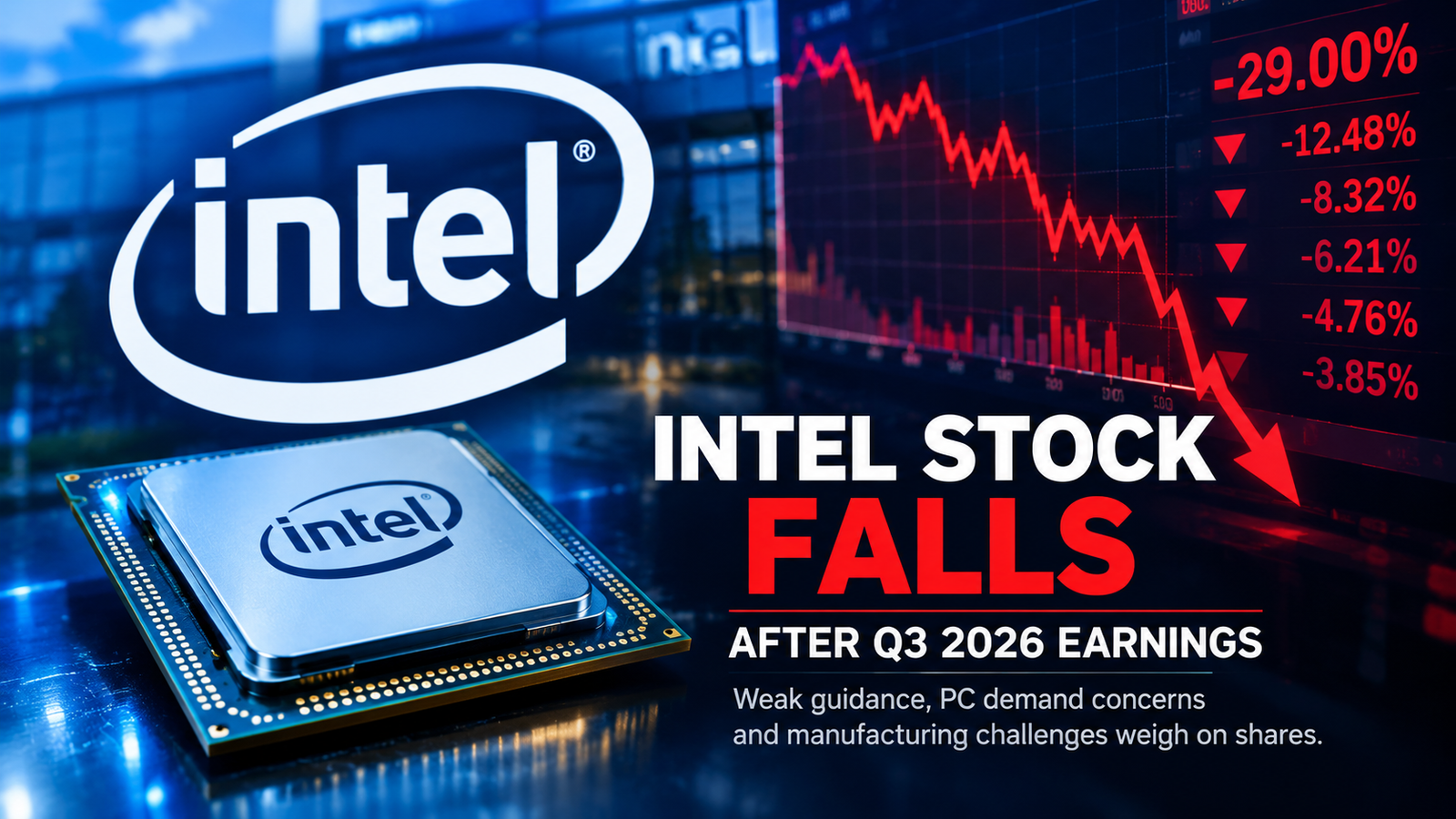
Intel stock is facing heavy selling pressure after the semiconductor company released its third-quarter 2026 financial results and issued a weaker-than-expected outlook for the final quarter of the year.
Although Intel beat expectations for adjusted earnings, investors focused on its disappointing fourth-quarter revenue forecast, declining PC-chip sales and ongoing manufacturing challenges. The company’s warning about continued weakness in the PC market has also raised concerns about its turnaround plans.
On Friday, October 30, Intel shares dropped sharply, falling approximately 29% during the trading session, according to market reports.
The decline has attracted attention from investors searching for Intel stock news, INTC stock updates and an explanation of what could happen next.
Here’s what happened, why Intel shares are falling and what investors should know about the company’s latest results.
Why Is Intel Stock Falling Today?
Intel stock is falling mainly because investors were disappointed by the company’s fourth-quarter guidance.
Intel reported better-than-expected adjusted earnings for Q3 2026. However, its forecast for the next quarter was below Wall Street expectations.
The company expects fourth-quarter revenue between $15 billion and $16 billion, compared with analysts’ expectations of approximately $17.07 billion.
Intel also warned that the PC-market slowdown could continue through at least the first half of 2027.
Several factors have contributed to the negative reaction:
- Weak PC demand: Intel’s client-computing business reported lower revenue.
- Manufacturing constraints: Production limitations have affected its ability to meet demand.
- Higher memory prices: Rising component costs are putting additional pressure on PC demand.
- Cash-flow concerns: Intel warned that it does not expect positive cash flow this year.
- Weaker guidance: Its fourth-quarter forecast disappointed investors despite a stronger third quarter.
These concerns have increased uncertainty about Intel’s financial recovery and future growth.
Intel Q3 2026 Earnings: What Did the Company Report?
Intel’s third-quarter results showed improvement in several important financial areas.
The company reported revenue of approximately $16.5 billion, representing 21% growth compared with the same period last year.
Its adjusted earnings per share also increased, reaching $0.52.
However, the results were mixed across different business segments.
Intel Q3 2026 financial results
| Financial metric | Q3 2026 result |
|---|---|
| Revenue | $16.5 billion |
| Revenue growth | 21% year over year |
| Non-GAAP earnings per share | $0.52 |
| GAAP earnings per share | $0.60 |
| Non-GAAP gross margin | 44.1% |
| Q4 revenue guidance | $15–16 billion |
The results demonstrate that Intel is making progress in some parts of its business. However, investors are concerned that the company’s near-term challenges could limit its growth.
Why Did Intel’s Fourth-Quarter Forecast Disappoint Investors?
Intel expects fourth-quarter 2026 revenue between $15 billion and $16 billion.
That forecast was below analysts’ expectations of approximately $17.07 billion.
The company also projected non-GAAP earnings per share of $0.25 for the quarter.
The weaker outlook reflects several challenges, particularly lower PC demand and limitations in manufacturing capacity.
Intel’s management has indicated that its immediate priority is increasing supply to meet strong demand for its Xeon server processors.
However, increasing production requires investment, and the company is facing pressure to balance manufacturing expansion with cash flow.
For investors, the concern is not simply that Intel missed expectations. It is that the company’s challenges may continue into 2027.
PC Market Weakness Is Hurting Intel
Intel’s traditional PC business remains an important part of its operations.
During Q3 2026, revenue from its client-computing segment declined 5% year over year to approximately $8.1 billion.
This was weaker than analysts had expected.
Higher memory prices are making computers more expensive, which could discourage consumers and businesses from upgrading their devices.
Intel’s management expects the PC slowdown to continue through at least the first half of 2027.
This creates uncertainty for Intel because its PC processor business remains exposed to changes in computer demand.
If the market remains weak, revenue from this segment could continue facing pressure.
Intel’s AI and Data Center Business Is Still Growing
Despite the pressure on Intel stock, the company’s data-center and AI business delivered a stronger performance.
Revenue from its Data Center and AI segment reached approximately $7.3 billion, representing growth of around 78% year over year.
Demand for server processors is increasing as companies expand their AI infrastructure and data-center capacity.
Intel’s Xeon processors are an important part of this business.
The growth suggests that Intel is benefiting from the wider demand for computing infrastructure, even while its traditional PC business struggles.
However, strong demand does not automatically translate into higher profits. Intel must also increase production capacity and manage the costs associated with expanding its manufacturing operations.
Manufacturing Problems Add More Pressure
Intel is also dealing with manufacturing challenges that could affect its ability to meet customer demand.
Reuters reported that an October explosion at the company’s Kiryat Gat facility in Israel caused a temporary shutdown and is expected to reduce revenue by approximately $600 million over two quarters.
The disruption has also affected the company’s ability to supply certain AI server chips.
This creates another challenge for Intel because demand for its data-center processors remains strong.
The company needs to increase production while dealing with operational disruptions and significant investment requirements.
These factors have added to investor concerns about its near-term financial outlook.
Is Intel Stock a Good Investment Right Now?
Intel’s latest earnings report presents both opportunities and risks.
On the positive side, the company reported revenue growth, stronger adjusted earnings and significant expansion in its data-center and AI business.
However, investors also need to consider its weaker fourth-quarter guidance, declining PC sales, manufacturing constraints and cash-flow concerns.
Before making an investment decision, it is worth examining several factors:
Potential positives:
- Growing demand for AI and data-center processors.
- Strong year-over-year growth in data-center revenue.
- Better-than-expected Q3 adjusted earnings.
- Continued investment in manufacturing and technology.
Potential risks:
- Continued weakness in the PC market.
- Manufacturing and supply limitations.
- Significant capital expenditure requirements.
- Uncertainty about future cash flow.
- Competition from AMD and other semiconductor companies.
Whether Intel stock is attractive depends on an investor’s risk tolerance, investment timeline and expectations for the company’s recovery.
A sharp share-price decline does not automatically make a stock undervalued.
Intel Stock vs. AMD: What Should Investors Watch?
Intel and AMD compete in several important semiconductor markets, including PC processors and data-center CPUs.
Both companies are affected by changes in computing demand, but their product portfolios and business strategies are different.
Intel is working to expand its manufacturing capabilities and strengthen its server processor business. AMD is also competing for demand from data centers and AI infrastructure.
Investors comparing the two companies should examine:
- Revenue growth across PC and data-center segments.
- Profit margins and operating performance.
- Manufacturing capacity and supply availability.
- Product competitiveness.
- Future earnings guidance.
The latest Intel results show strong data-center growth, but the company’s weaker PC performance and manufacturing constraints remain important concerns.
What Could Happen to Intel Stock Next?
Intel’s future share-price performance will depend on whether the company can improve its operations and meet demand for its processors.
Investors will likely pay close attention to several developments over the coming months.
1. Fourth-quarter financial results
The next earnings report will help investors determine whether Intel’s guidance was accurate and whether the company can improve its financial performance.
2. PC-market recovery
A recovery in computer demand could support Intel’s client-computing business. Continued weakness could create further pressure.
3. AI processor demand
Demand for Xeon processors and data-center products could provide an important growth opportunity.
4. Manufacturing improvements
Intel needs to increase production capacity and resolve supply constraints to take advantage of demand.
5. Cash flow and spending
Investors will also watch whether Intel can manage its manufacturing investments while improving its financial position.
There is no guarantee that Intel shares will recover quickly. The latest results have created uncertainty, and future performance will depend on the company’s execution and broader market conditions.
Frequently Asked Questions
Why is Intel stock falling?
Intel stock fell after its Q3 2026 earnings report because investors were disappointed by its fourth-quarter revenue forecast, weak PC demand, manufacturing constraints and cash-flow outlook.
What is Intel’s stock ticker?
Intel trades on the Nasdaq stock exchange under the ticker symbol INTC.
Did Intel beat Q3 2026 earnings expectations?
Yes. Intel reported non-GAAP earnings per share of $0.52, above analysts’ expectations. However, its fourth-quarter outlook disappointed investors.
How much revenue did Intel report in Q3 2026?
Intel reported approximately $16.5 billion in third-quarter revenue, representing 21% growth year over year.
What is Intel’s Q4 2026 revenue forecast?
Intel expects fourth-quarter revenue between $15 billion and $16 billion.
Is Intel still growing in AI?
Yes. Intel’s Data Center and AI segment reported approximately $7.3 billion in Q3 revenue, up around 78% year over year.
Is Intel stock expected to recover?
Intel’s recovery will depend on its ability to improve manufacturing capacity, meet demand for server processors, stabilize its PC business and strengthen cash flow. Future share-price performance is uncertain.
Final Thoughts
Intel stock has come under significant pressure following its Q3 2026 earnings report, despite the company delivering better-than-expected adjusted earnings.
The main concern is its weaker fourth-quarter outlook, combined with declining PC-chip revenue, manufacturing challenges and uncertainty about cash flow.
At the same time, Intel’s data-center and AI business is showing strong growth, offering a potential opportunity as demand for computing infrastructure increases.
For investors, the next few quarters will be important. Intel needs to turn strong demand into reliable production, sustainable revenue growth and improved financial performance.
This article is for informational purposes only and does not constitute financial or investment advice. Stock prices can change rapidly, and investors should conduct their own research before making investment decisions.