NASA’s Neil Gehrels Swift Observatory is expected to re-enter Earth’s atmosphere on Wednesday, November 4, 2026, almost 22 years after its launch. The spacecraft is falling back toward Earth after a rescue mission failed to raise its orbit.
The exact re-entry time and location are not yet confirmed. However, the latest forecast from The Aerospace Corporation predicts re-entry at 09:11 UTC on November 4, with an uncertainty of 12 hours. NASA’s November 2 update previously reported a U.S. Space Force estimate of approximately 08:30 UTC, with an uncertainty of 11 hours.
Most of the spacecraft should burn up as it travels through the atmosphere. However, some dense components could survive and reach the ground. NASA estimates the risk of harm to anyone on Earth at approximately 1 in 2,100.
Here’s what we know about the NASA Swift telescope re-entry, when it could happen, where surviving debris might travel and what people should understand about the risk.
Last checked: November 3, 2026. This is a forecast update, not a report of a confirmed re-entry.
When Will the NASA Swift Telescope Re-Enter Earth?
The Neil Gehrels Swift Observatory is expected to re-enter Earth’s atmosphere on November 4, 2026. However, the predicted time can still change as the spacecraft approaches the atmosphere.
The latest available forecast from The Aerospace Corporation lists:
- Predicted date: November 4, 2026
- Predicted time: 09:11 UTC
- Uncertainty: Plus or minus 12 hours
- Forecast window: Approximately 21:11 UTC on November 3 to 21:11 UTC on November 4
NASA’s November 2 announcement reported a separate U.S. Space Force prediction of approximately 08:30 UTC on November 4, with an uncertainty of 11 hours.
These estimates are close, but they are not identical. The spacecraft’s changing orbit makes precise predictions difficult. Therefore, readers should treat both times as forecasts rather than a confirmed schedule.
What Time Is the Swift Re-Entry in Pakistan?
The Aerospace Corporation’s central prediction of 09:11 UTC converts to 2:11 p.m. Pakistan Standard Time (PKT) on November 4.
Its 12-hour uncertainty creates an approximate window from 2:11 a.m. on November 4 to 2:11 a.m. on November 5 in Pakistan.
NASA’s earlier central estimate of 08:30 UTC converts to 1:30 p.m. PKT on November 4.
These times may change as tracking teams receive new orbital data. In addition, the actual re-entry could happen over an ocean or a region far from where people expect to see it.
For the latest information, check NASA’s official Swift mission updates and The Aerospace Corporation’s live re-entry prediction.
What Is the Neil Gehrels Swift Observatory?
The Neil Gehrels Swift Observatory is a NASA space telescope designed to detect and study gamma-ray bursts. These powerful flashes of energy can come from some of the most extreme events in the universe, including the collapse of massive stars and the collision of neutron stars.
NASA launched Swift on November 20, 2004. The mission originally had a planned primary duration of two years. However, the observatory continued working for almost 22 years.
Swift carried three scientific instruments:
- Burst Alert Telescope: Detected sudden bursts of gamma rays across large areas of the sky.
- X-Ray Telescope: Studied the X-ray light that followed many of those events.
- Ultraviolet/Optical Telescope: Captured visible and ultraviolet observations of cosmic objects.
The spacecraft could respond quickly when it detected a gamma-ray burst. It also sent alerts to other observatories so scientists could study the same event.
Over its long mission, Swift helped researchers investigate gamma-ray bursts, supernovae, black holes, active galaxies and other cosmic events.
Its return to Earth marks the end of a mission that lasted far beyond its original plan.
Why Is NASA’s Swift Telescope Falling Back to Earth?
Swift is returning because Earth’s upper atmosphere creates drag on spacecraft in low Earth orbit.
Even at high altitudes, the atmosphere contains a small amount of gas. As a spacecraft moves through it, that gas creates resistance and gradually lowers the spacecraft’s orbit.
Increased solar activity has made the upper atmosphere expand. This change increased atmospheric drag on Swift and accelerated its orbital decline.
By October 20, 2026, Swift had fallen to approximately 275 kilometers (171 miles) above Earth. At that altitude, increased drag made it difficult for the spacecraft to maintain the stable pointing needed for normal observations.
Swift entered safe mode, and its operations team at Pennsylvania State University sent a command that effectively ended the mission.
The observatory could no longer maintain or raise its orbit. As a result, it began its final descent toward Earth’s atmosphere.
This is an uncontrolled atmospheric re-entry. It does not mean that the spacecraft has crashed or that it will land intact.
Why Did NASA’s Swift Rescue Mission Fail?
NASA tried to extend Swift’s mission before allowing it to return to Earth.
In September 2025, NASA awarded Katalyst Space a contract to develop a robotic spacecraft that could capture Swift and raise its orbit. The rescue vehicle was called LINK.
The plan was ambitious. LINK would approach Swift, position itself near the observatory and use its robotic capture system to attach to the spacecraft. It would then attempt to boost Swift into a higher orbit.
However, the rescue did not go as planned.
NASA announced on August 18, 2026, that LINK would not capture or boost Swift because of an ongoing attitude-control problem. The issue prevented the spacecraft from carrying out the planned rescue.
Although LINK could still attempt rendezvous and proximity operations, it could not complete the orbit-raising mission.
LINK later completed its own mission and re-entered Earth’s atmosphere in September 2026, according to reporting by UPI.
The failed rescue left Swift without a way to return to a higher orbit. Consequently, NASA prepared for the observatory’s eventual re-entry.
For more background, read our earlier report: NASA Swift Telescope Rescue Mission Failed: Why the Observatory Is Falling Back to Earth.
Where Could NASA Swift Telescope Debris Land?
NASA says surviving fragments from Swift’s re-entry could fall within a latitude band between 20.6 degrees south and 20.6 degrees north.
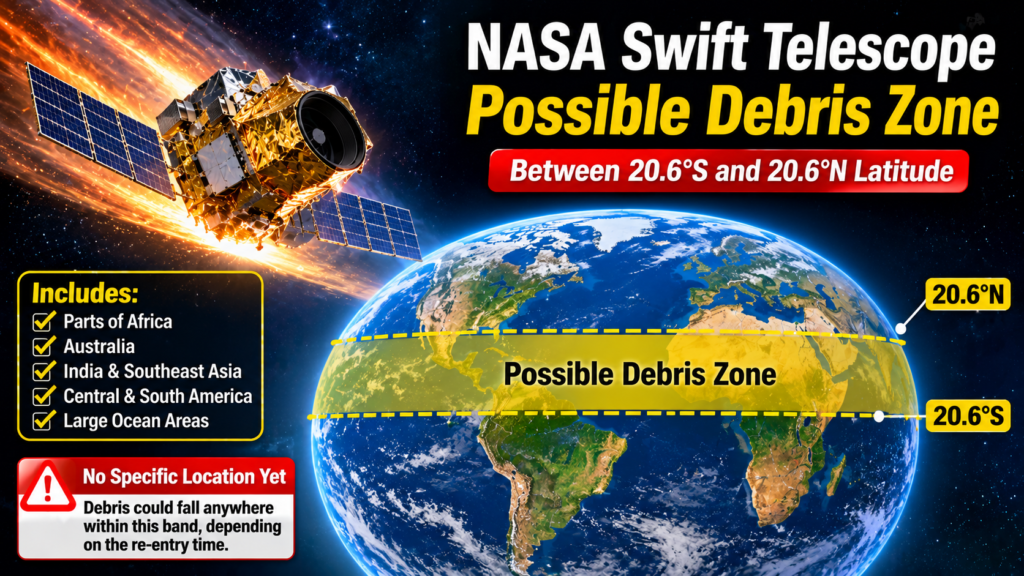
This band covers parts of the tropical regions and crosses several areas of the world, including:
- Parts of Africa
- Northern Australia
- India and parts of South Asia
- Southeast Asia
- Central America
- Parts of South America
- Large areas of the Atlantic, Pacific and Indian oceans
However, this latitude range does not identify a confirmed landing location.
The actual debris path depends on the exact time and position of re-entry. A change of only a few hours could put the spacecraft over a completely different section of its orbit.
The Aerospace Corporation’s tracking map shows the possible ground-track corridor. Areas outside the predicted track are not exposed to debris from that particular forecast.
Therefore, it would be misleading to claim that Swift will land in a particular country, city or ocean before the final tracking data becomes available.
Could Swift Debris Reach Pakistan or the United States?
NASA’s published latitude range places possible surviving debris between 20.6 degrees south and 20.6 degrees north.
Pakistan lies north of that range, while the continental United States also lies outside it. Therefore, neither is within the stated debris latitude band.
However, the exact ground track still matters for countries and regions inside the band. The latitude range should not be treated as a prediction that every location within it faces the same exposure.
What Will Burn Up and What Could Survive?
Most of Swift is expected to burn up as it passes through Earth’s atmosphere.
During re-entry, the spacecraft will encounter increasingly dense air. The resulting heating and physical forces will break apart and destroy much of its structure.
However, not every component will necessarily disappear.
NASA’s mission team has said that some dense components could survive. These may include:
- Tungsten components: Tungsten is very dense and has a high melting point, making some pieces more resistant to extreme heat.
- Mirror components: Some parts of the observatory’s mirrors could also survive the journey through the atmosphere.
These are possibilities, not confirmed outcomes. NASA has not identified a confirmed surviving fragment or landing location.
The spacecraft weighs approximately 3,200 pounds (about 1,500 kilograms). That does not mean all of this material will reach the ground. Most of the structure is expected to burn up during re-entry.
Is the NASA Swift Telescope Re-Entry Dangerous?
NASA estimates the risk of harm to anyone on Earth at approximately 1 in 2,100.
The agency describes the risk as unlikely. Nevertheless, the figure is not zero, which is why NASA and the U.S. Space Force continue to monitor the spacecraft.
The risk applies to the possibility of harm to someone on Earth from the re-entry. It is not a prediction that a particular person or city will be hit.
Most of the spacecraft should burn up, and any surviving fragments could fall across a large ocean or land corridor.
If you believe you have found a piece of spacecraft debris, do not touch or move it. Keep a safe distance and report it to local authorities. A photograph or social media post alone cannot confirm that an object came from Swift.
Will You Be Able to See Swift Re-Enter?
It is possible, but visibility depends on the spacecraft’s final path, the time of re-entry, local weather and whether the event occurs over a populated area.
A large spacecraft breaking apart in the atmosphere can produce a bright, moving trail. Some fragments may appear as separate glowing objects as the structure breaks up.
However, there is no reliable viewing location or confirmed time yet.
People should not travel to a particular place based on an unverified prediction. They should also be careful with videos shared online. Footage of other satellites, rocket stages and meteors can easily be mistaken for the Swift re-entry.
NASA and space-tracking organizations will provide more reliable information as the final orbital predictions become clearer.
What Happens After the Swift Observatory Re-Enters?
NASA and the U.S. Space Force will continue tracking Swift as it approaches the atmosphere.
After re-entry, officials may provide a more precise time and information about the spacecraft’s final path. If people report possible debris, authorities and specialists will need to assess those reports before identifying any object as part of Swift.
The important distinction is between a predicted re-entry and a confirmed event.
Until NASA or another responsible authority confirms the outcome, reports about the exact landing location or surviving debris should be treated with caution.
XYZLENS will update this article when reliable information becomes available.
Frequently Asked Questions
When will the NASA Swift telescope fall to Earth?
NASA expects the Neil Gehrels Swift Observatory to re-enter Earth’s atmosphere on November 4, 2026. The latest Aerospace Corporation forecast lists 09:11 UTC, with an uncertainty of 12 hours. The exact time is not confirmed.
What time will the Swift telescope re-enter in Pakistan?
The latest Aerospace Corporation central estimate converts to 2:11 p.m. PKT on November 4. Its forecast window extends approximately from 2:11 a.m. on November 4 to 2:11 a.m. on November 5.
Where will the NASA Swift telescope debris land?
NASA says possible surviving fragments are limited to a latitude band between 20.6 degrees south and 20.6 degrees north. The exact ground track and landing location remain unknown.
Could the Swift telescope hit the United States?
The stated debris latitude band excludes the continental United States. NASA has not identified a confirmed landing location.
Is the falling NASA telescope dangerous?
NASA estimates the risk of harm to anyone on Earth at approximately 1 in 2,100. Most of the spacecraft should burn up, although some components could survive.
What parts of the Swift telescope could survive re-entry?
Some dense tungsten components and mirror parts could survive. However, NASA has not confirmed that any specific pieces will reach the ground.
Why did NASA fail to save the Swift Observatory?
NASA’s planned rescue vehicle, LINK, experienced an attitude-control problem. As a result, it could not capture or boost Swift into a higher orbit.
How long did the Swift space telescope operate?
Swift launched on November 20, 2004, and operated for almost 22 years. Its original primary mission was planned to last two years.
Final Thoughts
The NASA Swift telescope re-entry marks the end of a remarkable space mission that lasted almost 22 years. Although the observatory is expected to return to Earth’s atmosphere on November 4, the exact time and location remain uncertain.
NASA expects most of the spacecraft to burn up, while some dense components could survive. The agency’s estimated risk of harm to anyone on Earth is approximately 1 in 2,100.
For now, the most important details are the changing re-entry forecast, the possible debris corridor and NASA’s safety assessment. As the spacecraft gets closer to Earth, tracking teams should be able to narrow the prediction window.
Sources
- NASA – Swift Observatory Expected to Re-Enter Earth’s Atmosphere
- The Aerospace Corporation – Swift Observatory Re-Entry Forecast
- NASA – Swift Boost Mission
- UPI – NASA Swift Telescope Expected to Fall Back to Earth
- ABC News – NASA Swift Telescope Re-Entry and Potential Debris
- Space.com – NASA’s Swift Space Telescope Is About to Crash to Earth
Forecasts and re-entry estimates can change. Check NASA and The Aerospace Corporation for the latest updates.
Editorial note: This article was prepared using forecasts and official information available on November 3, 2026. Forecasts may change. The article will be updated when authorities confirm the re-entry outcome.