The Dow Jones midterm rally delivered one of Wall Street’s biggest trading days in years after Democrats secured control of both chambers of Congress in the November 3, 2026, U.S. elections.
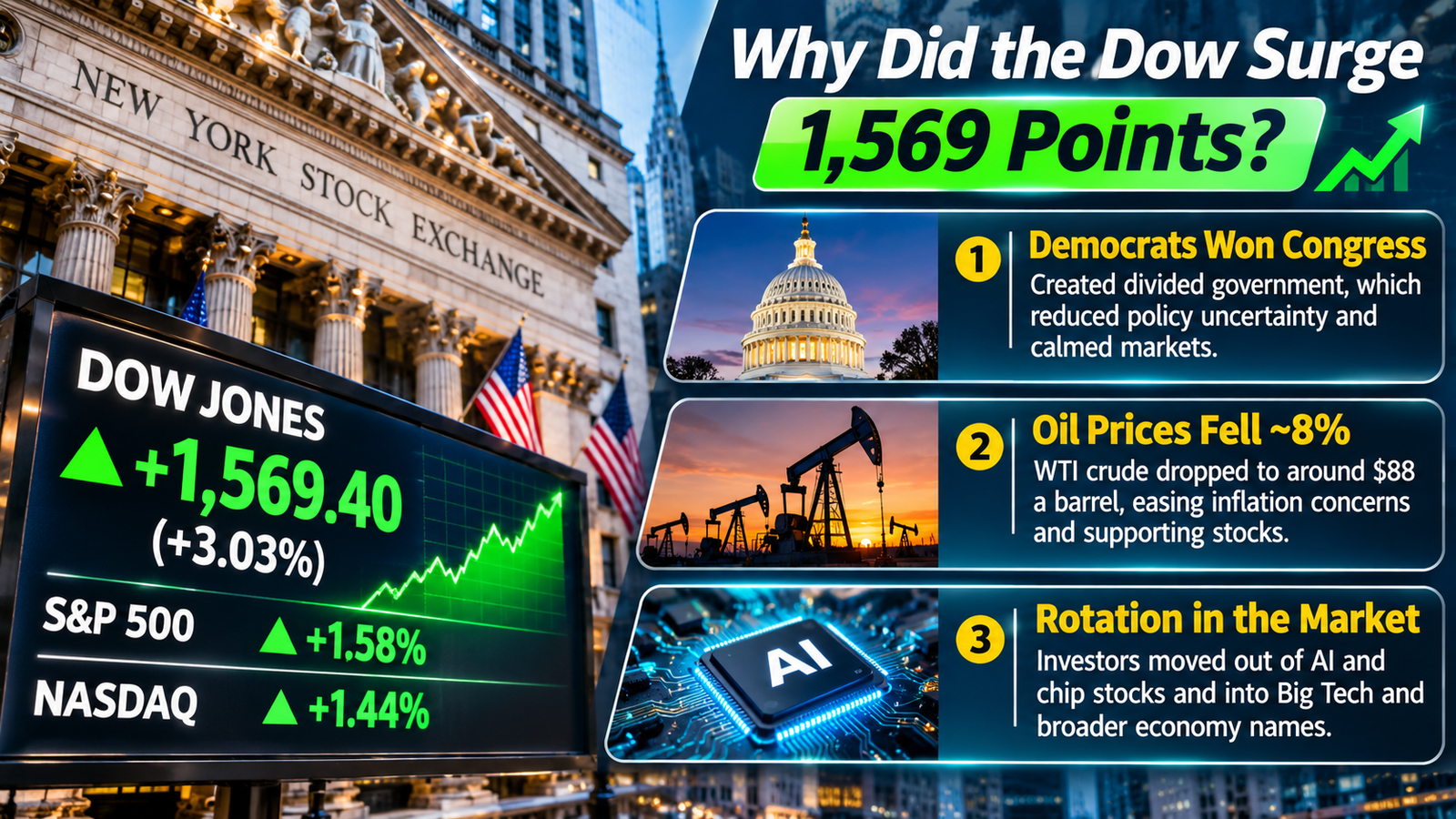
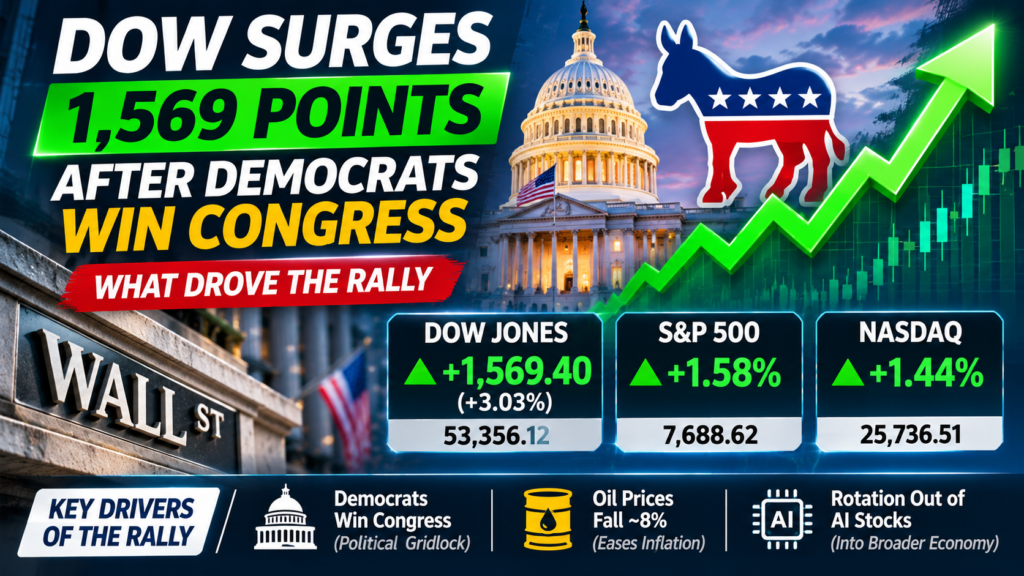
On Wednesday, November 4, the Dow Jones Industrial Average surged 1,569.40 points, or 3.03%, to close at 53,356.12. It was the index’s strongest daily performance since April 9, 2025, and its biggest post-midterm election rally since 1982.
However, the rally was not driven by election results alone.
Falling oil prices, expectations of political gridlock in Washington, lower bond yields, and a major shift between technology sectors all contributed to the market’s dramatic performance.
While companies including Apple, Microsoft and Amazon gained, several semiconductor and AI infrastructure stocks declined.
That contrast reveals an important detail: investors were not simply buying everything. Instead, they were reassessing which businesses might benefit from the changing political and economic outlook.
Here is what happened, why stocks surged, which companies gained or lost, and what investors will be watching on Thursday, November 5.
Updated November 5, 2026. Market figures refer to the completed U.S. trading session on November 4 unless otherwise specified.
Dow Jones Midterm Rally: What Happened on November 4, 2026?
U.S. stocks closed sharply higher on Wednesday after Democrats won majorities in both the House of Representatives and the Senate.
The election outcome ended weeks of political uncertainty and raised expectations that divided government could limit major changes to economic policy.
Meanwhile, crude oil prices plunged as traders assessed whether the new political balance could increase pressure to reduce U.S. involvement in the conflict with Iran.
The combination supported a broad rally across major U.S. stock indexes.
U.S. Stock Market Closing Results
| Market index | November 4 closing level | Daily change |
|---|---|---|
| Dow Jones Industrial Average | 53,356.12 | +3.03% |
| S&P 500 | 7,688.62 | +1.58% |
| Nasdaq Composite | 25,736.51 | +1.44% |
The Dow gained 1,569.40 points, while the S&P 500 added 119.70 points and the Nasdaq Composite rose 364.50 points.
The Dow also closed above the 53,000 level for the first time since September 8, 2026.
According to reporting citing CFRA Research, the November 4 advance was the Dow’s biggest single-day gain following a midterm election since 1982.
It was also the fifth-largest one-day point increase in the index’s history.
However, point gains alone do not tell the entire story.
As index values increase over time, larger numerical moves become more common. The 3.03% percentage increase provides a more useful comparison with past market sessions.
Source: Reuters — Wall Street ends higher after Democrats win Congress.
Why Did the Dow Jones Surge 1,569 Points?
There was no single explanation for Wednesday’s rally.
Instead, three major developments influenced investor sentiment: the election outcome, falling oil prices, and changes in how investors valued major technology businesses.
Understanding these factors helps explain why the Dow outperformed the S&P 500 and Nasdaq.
1. Democrats Won Congress, Reducing Political Uncertainty
The November 3 midterm elections produced a decisive victory for Democrats.
The party secured enough seats to take control of both the House of Representatives and the Senate, reversing the Republican majorities elected in 2024.
However, President Donald Trump remains in the White House.
As a result, the incoming Congress will create a divided-government arrangement, with the presidency controlled by Republicans and Congress controlled by Democrats.
The newly elected Congress is scheduled to convene on January 3, 2027. Therefore, the November election outcome does not mean the new Democratic majorities immediately took office.
Why Does Wall Street Sometimes Prefer Divided Government?
Investors frequently view political gridlock as a source of policy predictability.
When the president and Congress belong to opposing parties, sweeping legislative changes generally become more difficult.
For businesses, this may reduce the risk of unexpected changes involving taxes, federal spending, regulations or government programs.
In the current environment, investors are particularly focused on tariffs, federal debt, the Iran conflict and the rapidly expanding artificial intelligence industry.
Following the midterm results, traders began adjusting their expectations for these policies.
However, divided government does not eliminate uncertainty.
The president retains executive powers and veto authority, while Congress controls important aspects of spending and legislation. Disagreements could also create budget standoffs.
Therefore, Wednesday’s rally reflects how investors interpreted the election outcome, not proof that any particular policy will succeed.
According to Reuters, market strategists described the election as reducing uncertainty and increasing expectations of a more predictable legislative environment.
Source: Reuters — Markets cheer Democratic win as investors anticipate fewer policy shocks.
2. Oil Prices Plunged as Investors Reassessed the Iran War
Falling oil prices were another major driver of the stock market rally.
Crude oil dropped sharply on November 4 as investors considered whether the Democratic victory could lead to a less aggressive approach toward the U.S.–Iran conflict.
West Texas Intermediate, the U.S. crude benchmark, fell approximately 8% and traded around $88 per barrel during the session.
Meanwhile, Brent crude dropped approximately 8.7% to $94.62 per barrel.
The move reflected expectations that political pressure in Washington might increase the possibility of de-escalation.
However, lower oil prices do not mean the conflict has ended. The market was responding to expectations, not a confirmed peace agreement.
Why Do Falling Oil Prices Help Stocks?
Oil prices influence multiple areas of the economy.
When crude oil becomes cheaper, businesses may face lower transportation and production costs.
Airlines, manufacturers, logistics providers and companies that depend heavily on fuel can benefit when energy expenses decline.
Consumers may also benefit if lower crude prices eventually translate into cheaper gasoline and transportation.
Additionally, lower energy costs can reduce inflationary pressure.
That matters because inflation affects expectations for Federal Reserve interest-rate policy.
If inflation pressures ease, investors may become more optimistic about future borrowing costs and economic growth.
Still, these effects depend on whether lower energy prices persist.
A single session of falling oil prices does not guarantee that consumer inflation will decline.
What Happened to Energy Stocks?
Not every industry welcomed the decline.
Energy shares were among Wednesday’s weakest performers.
According to Reuters, the S&P 500 energy sector fell approximately 4.8% as crude prices declined.
Lower oil prices can reduce revenue expectations for oil producers, particularly when investors believe the decline may continue.
Therefore, the same event that supported the broader stock market created pressure on energy companies.
This illustrates why a strong day for an index does not necessarily mean every industry benefits.
3. Investors Rotated Away From Some AI Stocks
The third major development involved artificial intelligence.
AI-related stocks have played an important role in market performance over recent years, particularly companies involved in semiconductor manufacturing, cloud computing and data-center construction.
However, Wednesday’s trading revealed an unusual split within the sector.
Large technology companies rallied strongly while several AI infrastructure businesses suffered substantial losses.
The reason was connected to changing expectations about regulation and future spending.
Why Were AI Infrastructure Stocks Falling?
Investors became concerned that Democratic victories could increase political scrutiny of data-center development.
Large data centers require enormous amounts of electricity, land, cooling equipment and infrastructure.
In several states, local opposition has increased because of concerns about energy costs, water consumption and the impact of construction.
Following the elections, traders began considering whether additional restrictions could slow the expansion of new facilities.
That possibility affected businesses whose growth depends directly on data-center construction.
For example, CoreWeave declined around 10%, while Hut 8 dropped approximately 23%.
The Philadelphia Semiconductor Index also fell 3.1%.
Nvidia, one of the most closely watched AI stocks, declined approximately 3%.
These declines reflected investor concerns about future spending and regulation rather than evidence that demand for AI technology had disappeared.
Why Did Microsoft and Amazon Rise?
Interestingly, some of the companies investing heavily in artificial intelligence performed much better.
Microsoft gained around 6.7%, while Amazon advanced approximately 6.1%.
One explanation is that investors believe slower data-center expansion could reduce capital-spending pressure on large technology companies.
Building and operating AI infrastructure requires significant investment.
If companies face fewer immediate construction commitments, their future cash-flow outlook could improve.
However, the impact is complicated.
Slower infrastructure expansion could also limit the speed at which AI services grow.
That is why Wednesday’s trading should be understood as a reassessment of business expectations rather than a clear judgment on the long-term future of artificial intelligence.
Dow Jones Rally: Biggest Stock Market Winners
Several major U.S. companies posted substantial gains on November 4.
The strongest performances came from a mixture of technology, industrial and consumer-related businesses.
Apple
Apple shares climbed approximately 5.3% during Wednesday’s trading.
The company’s strong performance contributed to the broader rally among established technology businesses.
Investors continued to favor companies with significant cash flows, established products and the ability to withstand changing economic conditions.
Microsoft
Microsoft was among the day’s major technology winners, advancing approximately 6.7%.
Its performance helped lift the Dow despite weakness among semiconductor companies.
The rally also highlighted the distinction investors were making between major technology platforms and companies more directly exposed to the construction of AI infrastructure.
Amazon
Amazon gained approximately 6.1%, benefiting from the stronger sentiment toward large technology and consumer-related businesses.
Its diverse business model includes e-commerce, cloud computing, advertising and digital services.
Those operations expose Amazon to different parts of the economy, although the company also faces significant spending requirements for technology infrastructure.
3M
Industrial company 3M rose more than 9%, making it one of the session’s strongest Dow performers.
The gain came as investors favored businesses connected to broader economic activity.
Walmart and Bank of America
Walmart gained approximately 3%, while Bank of America advanced around 4%.
Their performance showed that Wednesday’s rally extended beyond technology.
Consumer, banking and industrial businesses also attracted buying interest.
Stock Market Winners at a Glance
| Company | Approximate November 4 change |
|---|---|
| 3M | +9.5% |
| Microsoft | +6.7% |
| Amazon | +6.1% |
| Apple | +5.3% |
| Bank of America | +4% |
| Walmart | +3% |
Percentages are rounded from reported November 4 trading data and are not live November 5 quotes.
Which Stocks Fell Despite the Market Rally?
Although the Dow surged, several prominent companies moved in the opposite direction.
The declines were particularly visible among semiconductor manufacturers, data-center businesses and some companies exposed to changes in federal policy.
Nvidia
Nvidia shares declined approximately 3%.
The company faced pressure as investors reassessed potential restrictions on data-center expansion and future demand for AI infrastructure.
CoreWeave
CoreWeave dropped approximately 10%.
The company is closely tied to the expansion of cloud and AI computing infrastructure, making it sensitive to changes in expected spending.
Hut 8
Hut 8 suffered an even sharper decline of approximately 23%.
The move reflected investor concerns about businesses dependent on large-scale computing and data-center projects.
Tesla and Defense Companies
Tesla also declined, losing approximately 3.3%.
Meanwhile, several defense contractors fell as investors considered how a Democratic Congress might affect military spending priorities.
These developments underline a crucial point: a rally in the Dow does not automatically mean all stocks rise.
Investors can simultaneously become more optimistic about the overall economy and more cautious about particular industries.
Why Did the Dow Outperform the Nasdaq?
Wednesday’s closing figures reveal a clear difference between the major indexes.
The Dow gained 3.03%, while the Nasdaq Composite rose 1.44%.
That difference reflects both the composition of the indexes and the types of companies that performed well.
The Dow Jones Industrial Average tracks 30 major U.S. companies and uses a price-weighted calculation.
This means stocks with higher share prices can have a greater impact on the index’s movement.
The Nasdaq Composite contains thousands of listed securities and has substantial exposure to technology-related businesses.
As semiconductor and AI infrastructure shares declined, that weakness limited the Nasdaq’s advance.
Meanwhile, strong gains among several Dow components helped the blue-chip index outperform.
The distinction is important because investors sometimes interpret a large Dow gain as evidence that the entire technology sector is rising.
Wednesday’s performance showed that the picture was more complicated.
Was This the Biggest Dow Jones Rally in History?
No. The November 4 rally was significant, but it was not the largest percentage gain in Dow history.
The index increased 3.03%, gaining 1,569.40 points.
According to Investopedia, it represented the fifth-largest single-day point gain in the Dow’s history.
However, the percentage increase was much smaller than some historic market rebounds.
For context, the Dow rose approximately 7.9% on April 9, 2025, after President Trump announced a pause in certain tariffs.
The November 2026 increase was therefore notable for its size, its timing and its connection to the midterm elections.
Financial research cited by multiple outlets characterized it as the strongest post-midterm rally since 1982.
This does not mean the market will continue rising at the same pace.
Large one-day advances can occur during both sustained recoveries and periods of significant volatility.
What Does the Dow Jones Midterm Rally Mean for Investors?
The rally provides insight into how financial markets are responding to the political landscape, but it does not establish the direction of stock prices for the coming weeks.
Three developments stand out.
First, markets responded positively to the removal of election uncertainty.
Second, falling energy prices improved expectations for inflation and economic conditions.
Third, investors reassessed the relative attractiveness of major technology companies, semiconductor manufacturers and businesses connected to AI infrastructure.
Together, these developments helped explain the surge.
However, individual investors should distinguish between a single trading session and a longer-term trend.
Does a Big Rally Mean Stocks Will Keep Rising?
Not necessarily.
A strong one-day gain can reflect relief after uncertainty rather than the beginning of a sustained upward trend.
Future market performance will depend on corporate earnings, inflation, Federal Reserve policy, geopolitical developments and the actions of the incoming Congress.
Any of those factors could strengthen or weaken investor confidence.
Could Falling Oil Prices Lower Inflation?
Potentially, but only if the decline continues and affects broader energy costs.
Lower fuel prices can reduce transportation and production expenses.
However, inflation also depends on housing, services, wages and many other factors.
Therefore, an oil-price decline alone cannot determine the future path of inflation.
Does Political Gridlock Guarantee a Strong Stock Market?
No.
Divided government may reduce the likelihood of sudden legislative changes, which some investors welcome.
However, it can also lead to disputes over spending, government funding and other economic policies.
The November 4 rally was a market reaction to expected outcomes, not proof of what the next Congress will accomplish.
What to Watch on Thursday, November 5, 2026
Following Wednesday’s powerful advance, investors are watching whether the market can maintain its momentum.
Several developments could influence the next trading sessions.
1. Whether the Dow Holds Its Gains
The immediate question is whether buying interest continues after the 1,569-point jump.
Traders will watch whether the Dow remains above 53,000 and whether other major indexes participate.
A strong follow-through session would suggest continued optimism, while a reversal could indicate profit-taking or renewed uncertainty.
2. Oil Prices and Developments Involving Iran
Oil remains a key factor.
Any credible diplomatic development, change in military activity or shift in supply expectations could influence crude prices.
Markets are particularly sensitive because energy costs affect inflation and business spending.
3. Semiconductor and Data-Center Stocks
Nvidia, CoreWeave and other AI-related businesses will remain closely watched.
Investors want to understand whether Wednesday’s declines were a temporary reaction or the beginning of a broader reassessment of future infrastructure spending.
Further statements from policymakers or companies could influence the sector.