
Democrats have won control of both the US House of Representatives and the Senate in the 2026 midterm elections, ending Republican control of Congress and setting up a new period of divided government under President Donald Trump.
The November 3 elections brought significant Democratic gains across the country, including victories in states that have traditionally supported Republicans. Results in Texas, Kansas, South Carolina and Michigan were among the most closely watched developments of election night.
According to the Associated Press and Reuters, voter concerns about the cost of living, the war with Iran and government accountability played major roles in the election. The results will give Democrats greater authority to challenge the Trump administration during the final two years of his presidency.
While control of Congress has been decided, several individual races were still being counted early Wednesday, November 4.
Who Won the 2026 US Midterm Elections?
Democrats emerged from the 2026 midterms with projected majorities in both chambers of Congress.
The outcome marks a significant change from the previous two years, when Republicans controlled the House, Senate and White House.
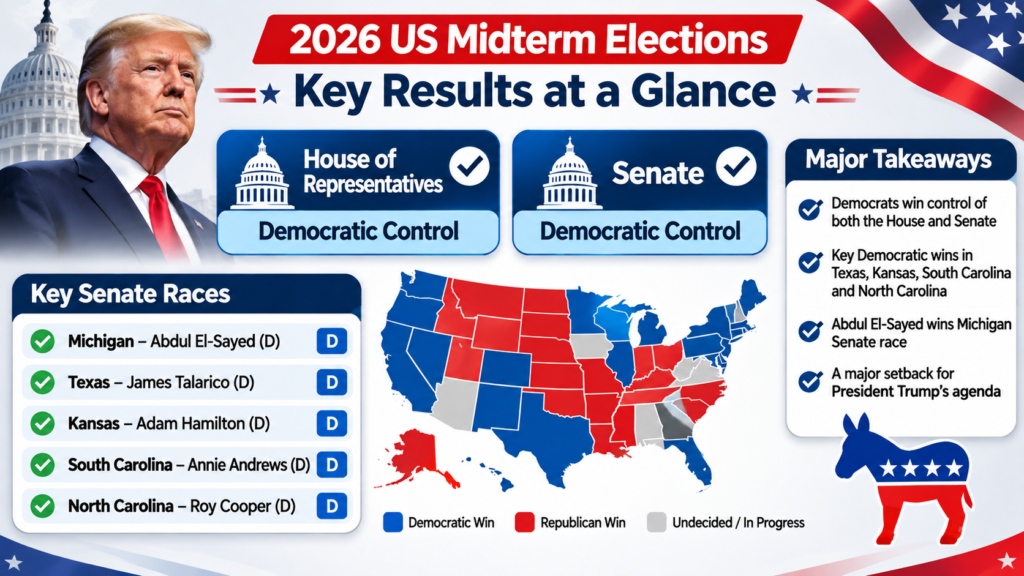
The election results mean Democrats will be able to shape congressional investigations, influence federal spending negotiations and decide which legislation advances through Congress.
Here is the overall picture from the November 4 reporting:
| Election | Result |
|---|---|
| US House of Representatives | Democratic majority |
| US Senate | Democratic majority |
| Michigan Senate race | Abdul El-Sayed (Democrat) |
| Texas Senate race | James Talarico (Democrat) |
| Kansas Senate race | Adam Hamilton (Democrat) |
| South Carolina Senate race | Annie Andrews (Democrat) |
| North Carolina Senate race | Roy Cooper (Democrat) |
These results reflect reported election-night race calls. They are not final certified vote totals.
The Democratic victories were notable not only because of the change in congressional control but also because several came in states where the party had struggled to win statewide elections for decades.
2026 Senate Election Results: Democrats Gain Control
The US Senate was one of the biggest battlegrounds of the 2026 elections.
Republicans entered the election with a Senate majority, while Democrats needed to gain seats to take control of the chamber.
By early Wednesday, Democratic victories in several competitive and traditionally Republican states had secured the party’s Senate majority.
Texas: James Talarico Wins Senate Race
Democrat James Talarico defeated Republican Ken Paxton in the Texas Senate election, according to Reuters.
The result ended a decades-long period without a Democratic victory in a US Senate race in Texas.
Texas has been a major Republican stronghold in national elections. Talarico’s victory therefore became one of the most significant results of the night.
Democrats also won the Texas governor’s race, with Gina Hinojosa defeating Republican incumbent Greg Abbott.
Kansas: Adam Hamilton Wins Historic Victory
Kansas elected Democrat Adam Hamilton to the US Senate, breaking a Republican winning streak that had lasted for generations.
The result was particularly notable because Kansas had not elected a Democratic US senator since the 1930s.
The victory showed that Democratic gains extended beyond the states typically considered competitive during national elections.
South Carolina: Annie Andrews Wins Senate Seat
Democrat Annie Andrews won South Carolina’s Senate race, another major result in a state where Republicans had maintained a strong electoral advantage.
South Carolina supported Trump by a wide margin in the 2024 presidential election.
Andrews’ victory became part of a broader pattern of Democratic gains in Republican-leaning states.
North Carolina: Roy Cooper Flips Senate Seat
Former North Carolina Governor Roy Cooper also won a US Senate seat for Democrats.
North Carolina has long been considered an important battleground in national politics, with closely contested elections and shifting voter coalitions.
Cooper’s victory added to the Democratic gains that ultimately changed control of the Senate.
Michigan Election Results: Abdul El-Sayed Wins Senate Race
Michigan produced another closely watched result in the 2026 midterm elections.
Democrat Abdul El-Sayed defeated Republican Mike Rogers in the race for the state’s open US Senate seat, according to projections from CBS News and other major news organizations.
El-Sayed, a former Michigan health official, ran as a progressive Democrat after winning his party’s primary.
His victory also marked a historic milestone: he became the first Muslim elected to the United States Senate.
Unlike Democratic victories that flipped Republican-held seats, the Michigan result kept the seat under Democratic control following Senator Gary Peters’ decision not to seek reelection.
The race attracted national attention because Michigan is a politically competitive state that Trump carried in both 2016 and 2024.
2026 House Election Results: Democrats Retake the Majority
Democrats also regained control of the US House of Representatives, completing their congressional victory.
All 435 voting seats in the House were up for election on November 3.
Before the midterms, Republicans held a narrow majority. That made competitive suburban districts, closely divided communities and seats affected by redistricting particularly important to the outcome.
Democrats performed strongly in many of these contests.
Reuters reported that Democrats won all 20 of the closely watched House races that had been decided at the time of its early Wednesday report.
The Republican Party’s efforts to improve its position through congressional redistricting also failed to produce the results it had sought in several targeted districts.
Although some individual House races remained unresolved, the projected Democratic majority was already secure.
The new House majority will give Democrats control over committee leadership, the legislative agenda and congressional oversight.
Which States Flipped Blue in the 2026 Elections?
One of the biggest stories from the 2026 US election results was the Democratic Party’s performance in traditionally Republican states.
Major Senate gains included:
- Texas: James Talarico won a Senate seat previously held by Republicans.
- Kansas: Adam Hamilton became the state’s first Democratic US senator in nearly a century.
- South Carolina: Annie Andrews won a Senate seat in a long-standing Republican stronghold.
- North Carolina: Roy Cooper captured a Republican-held Senate seat.
- Ohio: Former Senator Sherrod Brown defeated Republican Senator Jon Husted.
These victories helped Democrats secure control of the Senate and demonstrated the geographical reach of their gains.
However, winning a Senate or governor’s race does not mean every county or congressional district in that state voted Democratic. Statewide results and individual district outcomes should be examined separately.
Why Did Democrats Win the 2026 Midterms?
The election followed months of debate over economic conditions, foreign policy and the direction of the federal government.
Several factors featured prominently in the campaign and in post-election voter surveys.
1. Cost of Living and Economic Concerns
High prices remained a central issue for voters.
Democratic candidates criticized the Trump administration’s economic policies, including tariffs, arguing that they contributed to rising costs for American households.
Republicans defended their broader economic agenda and emphasized their own proposals for growth and affordability.
According to post-election reporting, concerns about everyday expenses remained especially influential.
2. The War With Iran
The war with Iran also shaped the political environment.
The conflict raised concerns about energy prices, international stability and the costs of US military involvement overseas.
Democrats questioned the administration’s handling of the conflict, while Republicans defended the president’s foreign policy decisions.
The issue became part of the wider debate over the administration’s record.
3. Government Accountability
Congressional oversight and government accountability were major campaign themes.
Reuters reported that 70% of voters surveyed in national exit polling wanted Congress to place stronger checks on presidential power.
The finding helps explain why the balance of power in Washington became an important question for voters.
Election results reflect many influences, however, and no single issue explains every race.
Trump’s Reaction to the 2026 Midterm Results
President Donald Trump acknowledged the election outcome as Democrats gained control of Congress.
According to Reuters, Trump congratulated Democrats during an interview with Fox News and expressed willingness to work with the new congressional majority on certain issues, including immigration.
He also indicated that he would veto legislation he considered unacceptable.
The results create a different political situation for the remainder of Trump’s second term.
During the previous two years, Republicans controlled both chambers of Congress. Democratic majorities will now be able to challenge administration proposals and exercise greater oversight.
Trump will remain president, but passing legislation could require negotiations with Democratic congressional leaders.
What Happens Now That Democrats Control Congress?
The incoming Democratic majorities are expected to change how Washington operates.
When the newly elected Congress takes office in January 2027, Democrats will have opportunities to conduct investigations, hold oversight hearings and influence federal legislation.
The Senate will also have the authority to approve or reject presidential nominees, including federal judges and executive branch officials who require Senate confirmation.
At the same time, Democrats will need to work with the White House on legislation that requires the president’s signature.
That could create disagreements over federal spending, immigration, economic policy and other major issues.
It could also create opportunities for bipartisan agreements where both parties find common ground.
The practical impact will depend on the size of the Democratic majorities, the priorities of congressional leaders and the administration’s willingness to negotiate.
2026 US Election Results Map and Remaining Races
Although Democrats have secured control of Congress, counting continued in some individual races early Wednesday.
Reuters identified Alaska and Mississippi among the Senate contests that had not yet been called in its November 4 reporting.
Readers looking for an updated 2026 election results map can follow state-by-state and district-by-district returns through the Associated Press and other established election reporting organizations.
It is important to distinguish between a race projected for a candidate and one whose results have been officially certified.
A media race call is based on election analysis and available vote information. Certification takes place later through the relevant election authorities.
Frequently Asked Questions
Who won the 2026 US midterm elections?
Democrats won projected majorities in both the US House of Representatives and Senate in the November 3, 2026, elections.
Did Democrats win both the House and Senate?
Yes. The Associated Press, Reuters and NPR reported that Democrats secured control of both congressional chambers.
Who won the Michigan Senate race in 2026?
Democrat Abdul El-Sayed defeated Republican Mike Rogers, according to CBS News projections. El-Sayed became the first Muslim elected to the US Senate.
Did Democrats win the Texas Senate election?
Yes. Democrat James Talarico defeated Republican Ken Paxton, ending a decades-long Democratic losing streak in Texas US Senate elections.
What does the election result mean for Donald Trump?
Trump remains president. However, Democratic control of Congress means his administration will face greater congressional oversight and may encounter more difficulty advancing legislation without bipartisan support.
When will the new Congress take office?
The newly elected Congress is scheduled to begin its term on January 3, 2027.
Are all the 2026 election results final?
No. Although control of Congress has been determined through projected race calls, some individual contests remained unresolved early November 4. Official certification follows state election procedures.
The Bottom Line
The 2026 US midterm elections have changed the balance of power in Washington.
Democrats won control of both the House and Senate, while victories in Texas, Kansas, South Carolina and other key states highlighted the reach of their electoral gains.
For President Trump, the results mean the final two years of his presidency will take place under divided government.
For Congress, the change brings new leadership, greater oversight of the executive branch and a different approach to negotiations over federal policy.
The remaining vote counts will determine the exact size of each party’s majority, but the central outcome is already clear: Democrats will control Congress when the new legislative term begins in January 2027.
Sources and further reading
- Associated Press: Democrats win the US House and Senate
- Reuters: Democrats seize Congress in 2026 midterm elections
- CBS News: Abdul El-Sayed wins Michigan Senate election
- NPR: Democrats win full control of Congress
Reporting reflects information available on November 4, 2026. Individual vote totals, uncalled contests and certification status may change.