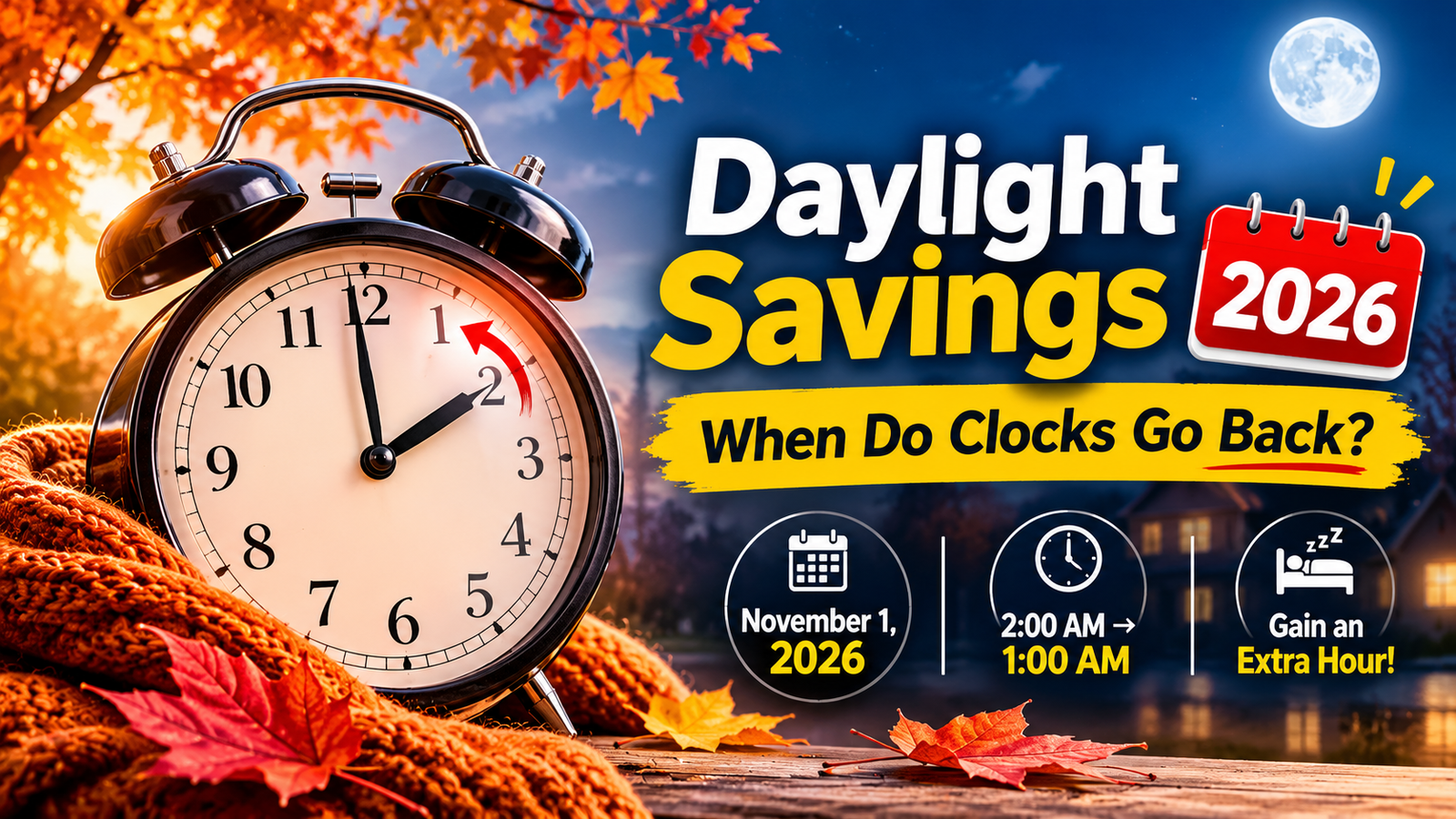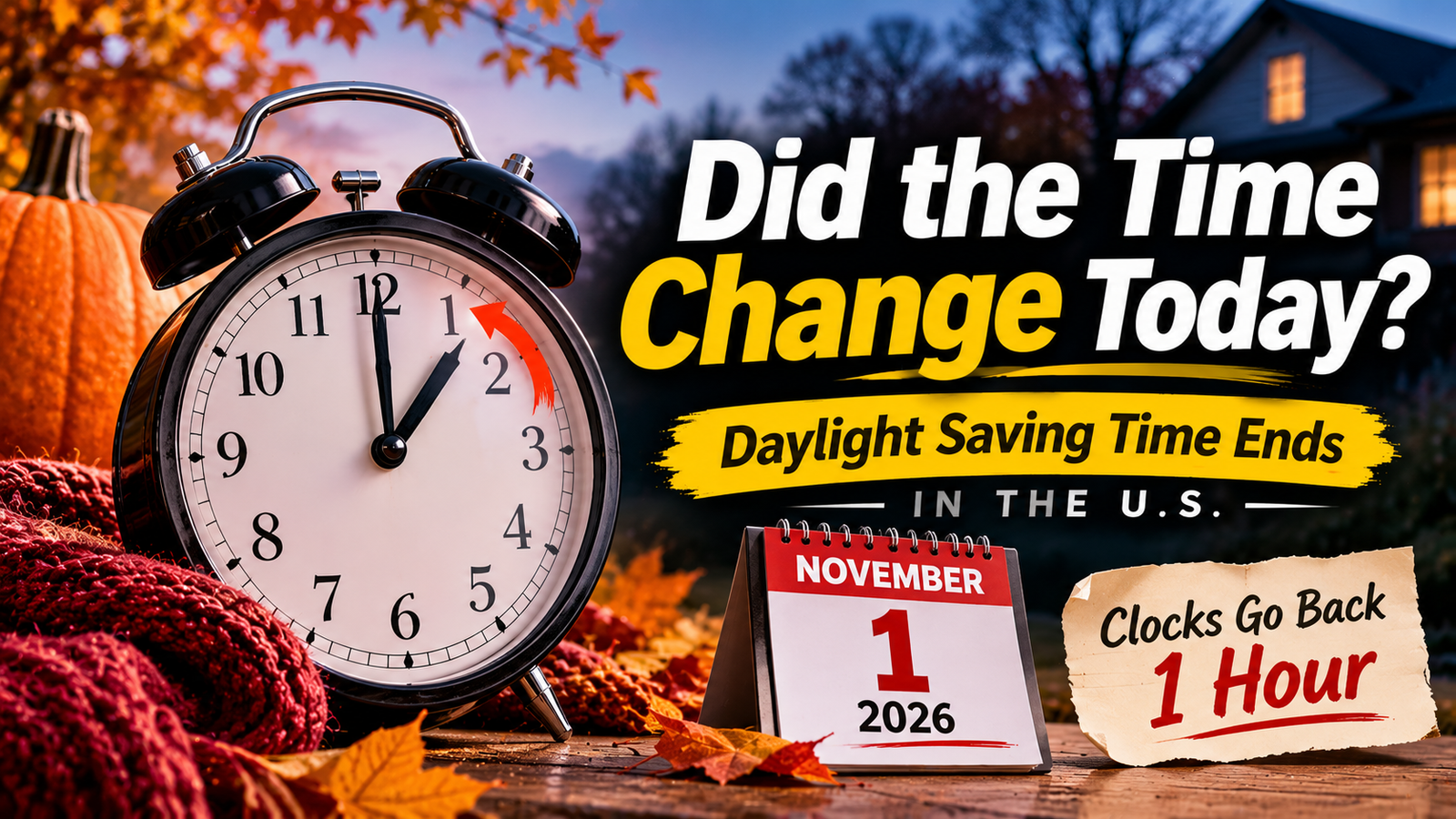
Yes, the time changed today in most of the United States. On Sunday, November 1, 2026, daylight saving time ended, and clocks moved backward by one hour. At 2:00 a.m. local daylight time, clocks returned to 1:00 a.m. standard time.
That means many Americans gained an extra hour overnight. If you woke up wondering whether your phone, computer, or wall clock was showing the correct time, the answer is that the annual fall time change has taken place.
The change affects most states, including Texas and California. However, some places do not observe daylight saving time, so the answer depends on where you live.
Did the Time Change Today in the USA?
Yes. Daylight saving time ended on November 1, 2026, in most of the United States.
The change happened at 2:00 a.m. local time. Instead of moving forward, clocks went backward by one hour:
- Before the change: 2:00 a.m. daylight time
- After the change: 1:00 a.m. standard time
- Result: One additional hour in the day
This is commonly called fall back because clocks move back one hour in autumn.
The National Institute of Standards and Technology confirms that daylight saving time in 2026 ran from March 8 through November 1. The transition back to standard time takes place at 2:00 a.m. local time on the first Sunday in November.
What Time Did the Time Change Today?
The clock change happened at 2:00 a.m. on Sunday, November 1, 2026.
At that moment, clocks in areas observing daylight saving time moved back to 1:00 a.m.
For example, someone in Dallas, Texas, would have experienced the following:
| Clock reading | What happened |
|---|---|
| 1:59 a.m. | Last minute before the change |
| 2:00 a.m. | Clocks moved back |
| 1:00 a.m. | The hour started again |
The same local-clock rule applies across the US time zones that observe daylight saving time. The actual UTC moment differs between time zones because the change occurs at 2:00 a.m. local time.
Did We Gain or Lose an Hour Today?
People in areas observing the time change gained one hour.
When clocks moved from 2:00 a.m. back to 1:00 a.m., the 1 a.m. hour happened twice. This made the overnight period one hour longer than it would have been without the change.
For many people, this means an extra hour of sleep. However, the benefit depends on individual schedules. People working overnight shifts may experience a longer shift because the clock repeats an hour.
The change also shifts daylight toward the morning. Sunrise and sunset will generally occur about one hour earlier by the clock compared with the previous day.
Did the Time Change in Texas and California?
Yes. Both Texas and California observe daylight saving time.
Their clocks moved back one hour on November 1, 2026.
The change also applies to most other US states, including New York, Florida, Illinois, Washington, Colorado, and Pennsylvania.
However, not every part of the United States follows the same seasonal clock schedule.
Which States and Places Do Not Observe Daylight Saving Time?
A few US states and territories do not observe daylight saving time.
These include:
- Hawaii: Does not observe daylight saving time.
- Most of Arizona: Remains on standard time throughout the year.
- American Samoa: Does not observe daylight saving time.
- Guam: Does not observe daylight saving time.
- Northern Mariana Islands: Does not observe daylight saving time.
- Puerto Rico: Does not observe daylight saving time.
- US Virgin Islands: Does not observe daylight saving time.
One important exception is the Navajo Nation in Arizona, which does observe daylight saving time.
Therefore, if you live in Hawaii or most of Arizona, your clock did not need to move backward today.
Why Did the Time Change Today?
The change happened because the United States follows a seasonal time system known as daylight saving time.
During the warmer months, clocks are moved forward one hour to provide more daylight during the evening. In autumn, clocks return to standard time.
Under current US rules:
- Daylight saving time begins on the second Sunday in March.
- Clocks move forward one hour in spring.
- Daylight saving time ends on the first Sunday in November.
- Clocks move backward one hour in autumn.
These dates are established under federal law. The US Department of Transportation oversees the country’s time zones and daylight saving time observance.
Did Phones and Computers Change Automatically?
Most modern smartphones, computers, and internet-connected devices update their clocks automatically when their time-zone and automatic-time settings are enabled.
If your device still shows the wrong time, check the following:
- Open your device’s date and time settings.
- Make sure automatic date and time is enabled.
- Check that the correct time zone is selected.
- Restart or reconnect the device if its displayed time has not updated.
Older clocks, watches, car displays, kitchen appliances, and some other devices may need to be adjusted manually.
It is also worth checking the time on alarms and other devices you rely on for important appointments.
When Is the Next Time Change in 2027?
The next daylight saving time change in most of the United States is scheduled for Sunday, March 14, 2027.
That is when clocks will move forward one hour, from 2:00 a.m. to 3:00 a.m. local standard time.
This change is commonly known as spring forward. Unlike the November transition, it means people lose one hour overnight.
The current federal schedule continues to use the second Sunday in March for the start of daylight saving time and the first Sunday in November for its end.
Frequently Asked Questions
Did the time change today, November 1, 2026?
Yes. Daylight saving time ended on November 1, 2026, in most of the United States. Clocks moved backward one hour at 2:00 a.m. local time.
Did the clocks go back or forward today?
The clocks went backward by one hour. At 2:00 a.m., the time returned to 1:00 a.m. This is known as falling back.
Did we gain an hour of sleep today?
Yes, people in areas observing daylight saving time gained an extra hour overnight because the 1:00 a.m. hour repeated.
What time did daylight saving time end today?
Daylight saving time ended at 2:00 a.m. local daylight time on November 1, 2026. Clocks then returned to 1:00 a.m. standard time.
Did the time change in California today?
Yes. California observes daylight saving time, so clocks moved back one hour on November 1, 2026.
Did the time change in Texas today?
Yes. Texas observes daylight saving time, so clocks moved back one hour on November 1, 2026.
Does Arizona change its clocks?
Most of Arizona does not observe daylight saving time and stays on Mountain Standard Time throughout the year. The Navajo Nation is an exception.
When will daylight saving time start again?
In most of the United States, daylight saving time is scheduled to begin again on March 14, 2027. Clocks will move forward one hour.
Final Answer: Did the Time Change Today?
Yes. On November 1, 2026, most Americans moved their clocks back one hour as daylight saving time ended. The change happened at 2:00 a.m. local time, when clocks returned to 1:00 a.m.
People in participating states gained an extra hour overnight, while Hawaii, most of Arizona, and several US territories did not make the seasonal change.
The next scheduled clock change in most of the country will take place on March 14, 2027, when daylight saving time begins again.
Sources to use in your article
These are authoritative references for the date, time, exceptions, and legal rules:
- NIST – Daylight Saving Time Rules — official 2026 dates and clock-change explanation.
- NIST – Official US Time — confirms November 1 and the one-hour change.
- US Department of Transportation – Uniform Time — federal time-zone and daylight saving rules.
- NIST – Local Time FAQs — automatic clocks and exceptions.
- Timeanddate – Dallas 2026 Time Changes — local Dallas time-change details.